What are the Basic Components in Electronics: Essential Guide
Are you curious about what makes your electronic devices work? Whether you’re a beginner or just want to understand the basics better, knowing the fundamental components in electronics is the key.
These small parts come together to create everything from your smartphone to your TV. You’ll discover the essential building blocks that power the gadgets you use every day. By the end, you’ll feel confident identifying these components and understanding their roles.
Ready to unlock the secrets behind electronics? Let’s dive in!
Fundamental Electronic Components
Electronic devices rely on basic parts to work properly. These parts control, store, and manage electric current. Knowing these parts helps understand how electronics function. They form the building blocks of all circuits.
Each component has a special job. Some resist current, some store energy, and others control the direction of flow. Together, they create complex systems from simple elements.
Resistors And Their Types
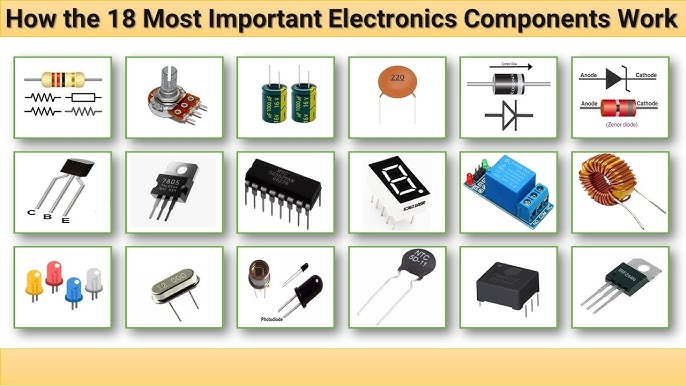
Resistors limit the flow of electric current. They protect parts from too much current. Different types serve different needs:
- Fixed resistors have one resistance value.
- Variable resistors change resistance by adjusting a knob or slider.
- Thermistors change resistance with temperature.
- Photoresistors change resistance with light levels.
Capacitors And Their Functions
Capacitors store and release electric charge. They smooth voltage changes and filter signals. Common types include:
- Ceramic capacitors for small values and high frequency.
- Electrolytic capacitors for large values and power supply filtering.
- Tantalum capacitors for stability in small sizes.
Inductors In Circuits
Inductors store energy in a magnetic field. They resist changes in current flow. They filter signals and store energy for power supplies. Inductors come in coils of wire around a core.
Diodes And Their Uses
Diodes allow current to flow in one direction only. They protect circuits and convert AC to DC. Types include:
- Standard diodes for general use.
- Zener diodes for voltage regulation.
- Light Emitting Diodes (LEDs) for light output.
Transistors As Switches And Amplifiers
Transistors control current flow in circuits. They act as switches to turn current on or off. They also amplify weak signals to stronger ones. Types include:
- Bipolar Junction Transistors (BJT) for switching and amplification.
- Field Effect Transistors (FET) for high input impedance applications.

Credit: www.electronicsandyou.com
Passive Components
Passive components form the backbone of almost every electronic circuit you encounter. Unlike active components, they don’t generate energy but instead store, dissipate, or control it within a system. Understanding these components can help you design, troubleshoot, or even innovate your own electronic projects.
Characteristics Of Passive Components
Passive components do not require an external power source to operate. They can’t amplify signals but can influence voltage, current, and resistance in a circuit. Their behavior is generally linear, meaning the output is directly proportional to the input.
Think about how a resistor limits current flow or a capacitor stores energy temporarily—these are simple yet crucial tasks. Their reliability often makes circuits more stable and predictable.
Have you ever wondered why these components don’t need power to function? It’s because they only respond to the signals already present in the circuit, making their operation energy-efficient and straightforward.
Common Passive Devices
- Resistors:Control current flow by providing resistance. They come in various types like fixed, variable, and thermistors.
- Capacitors:Store and release electrical energy. Used for filtering, timing, and tuning circuits.
- Inductors:Store energy in a magnetic field when current passes through. Often found in filters and transformers.
- Transformers:Transfer electrical energy between circuits through electromagnetic induction, changing voltage levels.
- Diodes:Though often considered active, some types like signal diodes act passively by allowing current in one direction only.
When you next open a gadget, try spotting these components. Understanding their roles might change how you view the device’s complexity and could inspire your own electronic creations.
Active Components
Active components are the heart of any electronic circuit. They have the unique ability to control the flow of electricity and amplify signals, giving your devices the power to perform complex tasks. Without active components, electronics would be limited to simple on/off functions.
Role Of Active Components
Active components control the current in a circuit. They can increase signal strength, switch currents on and off, and even generate energy. This ability allows your gadgets to process information, communicate, and respond to inputs dynamically.
Think about your smartphone screen brightness adjusting automatically or your audio device amplifying sound. These actions happen because active components manage how electricity flows and changes within the device.
Examples Of Active Devices
- Transistors:Often called the building blocks of modern electronics, transistors amplify signals and act as switches. Without them, computers and smartphones wouldn’t function.
- Diodes:These allow current to flow in one direction only, protecting circuits from damage and converting AC to DC power.
- Integrated Circuits (ICs):These tiny chips combine multiple active components to perform complex tasks like processing data or controlling devices.
- Vacuum Tubes:Though mostly replaced by transistors, vacuum tubes were the first active devices that amplified signals in early radios and televisions.
Have you ever wondered how your device switches between different tasks so seamlessly? It’s the active components working behind the scenes that make this possible. Next time you use any electronic gadget, think about the invisible role these parts play in making your experience smooth and responsive.
Semiconductor Devices
Semiconductor devices form the heart of modern electronics. These components control the flow of electricity in circuits. They make devices like computers, phones, and TVs work efficiently. Their unique properties allow for switching and amplification of electrical signals. Understanding semiconductor devices helps grasp how electronic gadgets operate.
Basics Of Semiconductors
Semiconductors are materials with electrical conductivity between conductors and insulators. Silicon is the most common semiconductor used in electronics. Its conductivity can change with temperature, light, or added impurities. This makes semiconductors ideal for controlling electrical current.
Pure semiconductors are not very conductive. Adding small amounts of impurities, called doping, increases conductivity. Two types of doping exist:
- N-type:Adds extra electrons, creating negative charge carriers.
- P-type:Creates holes or positive charge carriers by removing electrons.
The interaction between N-type and P-type materials forms the basis of many semiconductor devices.
Types Of Semiconductor Components
Common semiconductor components include:
- Diodes:Allow current to flow in one direction only.
- Transistors:Act as switches or amplifiers in circuits.
- Integrated Circuits (ICs):Combine many semiconductor devices on one chip.
- LEDs (Light Emitting Diodes):Emit light when current passes through them.
- Photodiodes:Convert light into electrical signals.
These components are essential in building complex electronic systems. Each type plays a specific role in circuit functionality.
Integrated Circuits
Integrated circuits form the heart of modern electronics. These tiny chips contain many electronic components packed into a small piece of semiconductor material. They perform complex functions while saving space and power. Integrated circuits have transformed how devices work, making them faster and more reliable.
Structure And Function
An integrated circuit consists of a silicon wafer with thousands or millions of tiny components. These include transistors, resistors, and capacitors. They connect through microscopic pathways to create electronic circuits. The chip is protected by a plastic or ceramic package with metal pins for connection.
Its function depends on the design. Some integrated circuits amplify signals, others process data or control devices. They handle tasks like computing, memory storage, and signal processing. Their small size allows many functions in one chip, reducing cost and power use.
Applications In Electronics
Integrated circuits appear in nearly all electronic devices. Common uses include:
- Computers and smartphones for processing and memory
- Television sets and radios for signal processing
- Automotive systems for engine control and safety features
- Home appliances like washing machines and microwaves
- Medical devices for monitoring and diagnostics
Their versatility makes electronics more compact and efficient. Integrated circuits enable complex functions in small gadgets we use daily.

Credit: www.youtube.com
Sensors And Actuators
Sensors and actuators form the bridge between the physical world and electronic systems. Sensors detect changes in the environment and send signals to the system. Actuators receive signals and perform actions that affect the environment. Together, they enable devices to interact with their surroundings effectively.
Types Of Sensors
Sensors come in many types, each designed to detect specific physical properties. Common types include:
- Temperature sensors – measure heat levels.
- Light sensors – detect brightness or light intensity.
- Motion sensors – sense movement or acceleration.
- Pressure sensors – measure force or pressure applied.
- Humidity sensors – detect moisture in the air.
- Proximity sensors – sense the presence of nearby objects.
Each sensor converts physical input into electrical signals. These signals help electronic devices understand their environment.
Role Of Actuators
Actuators change electrical signals into physical actions. They create movement, control mechanisms, or adjust systems. Common actuator types include motors, solenoids, and valves.
Actuators are essential in robotics, automation, and control systems. They respond to commands by moving parts or changing states. This action allows machines to perform tasks like opening doors, adjusting valves, or moving robotic arms.
Power Sources And Supplies
Power sources and supplies are the heart of any electronic device. Without a reliable way to provide energy, even the most advanced circuits won’t function. Understanding the types of power sources helps you choose the right one for your project or device.
Batteries And Cells
Batteries and cells store chemical energy and convert it into electrical energy. You probably use them daily in remote controls, smartphones, and flashlights. Each battery type offers different voltages and capacities, making some better for short bursts of power and others for long-term use.
Think about how your phone lasts all day on a lithium-ion battery, while a simple AA alkaline battery might drain quickly in a high-drain device. Choosing the right battery depends on your device’s power needs and how often you want to replace or recharge it.
Rechargeable batteries, like nickel-metal hydride (NiMH) or lithium-ion, save money over time and reduce waste. But disposable batteries can be more convenient for devices used infrequently. What’s your experience with battery life in everyday gadgets?
Power Supply Units
Power supply units (PSUs) convert electricity from an outlet into a usable form for electronic circuits. They regulate voltage and current to protect sensitive components from damage. You’ll find PSUs inside computers, TVs, and many home appliances.
PSUs come in different shapes and sizes depending on the device. A desktop computer PSU might provide multiple voltage levels, while a phone charger offers a fixed output. Knowing the specifications, like voltage, current, and wattage, ensures compatibility with your electronics.
Have you ever used a power supply that caused your device to overheat or malfunction? That’s often due to mismatched or poor-quality units. Investing in a reliable PSU can save you from frustrating repairs and extend your device’s life.

Credit: www.electronicsandyou.com
Connectors And Switches
Connectors and switches are key parts of any electronic device. They help connect different circuits and control the flow of electricity. Without them, devices would not work properly or safely. Understanding these components helps in building and repairing electronics.
Types Of Connectors
Connectors join wires or cables to electronic parts. They ensure a stable and secure connection. Different types fit different needs and devices.
- Pin Connectors:Small metal pins that fit into sockets. Used in computers and circuit boards.
- USB Connectors:Common in charging and data transfer. Found in phones, laptops, and gadgets.
- Coaxial Connectors:Used in TV cables and internet modems for strong signal transfer.
- Terminal Blocks:Allow wires to be connected and disconnected easily. Used in industrial electronics.
- Ribbon Cable Connectors:Connect flat cables to circuit boards, common in printers and scanners.
Switch Mechanisms
Switches control the flow of electricity by opening or closing a circuit. They come in various forms depending on how they operate.
- Toggle Switch:Moves up or down to turn a device on or off.
- Push Button Switch:Press to make or break a connection. Common in keyboards and calculators.
- Slide Switch:Slides back and forth to open or close circuits. Used in small electronics.
- Rotary Switch:Turns to select different circuit paths. Found in old radios and appliances.
- Proximity Switch:Activates without physical contact, using sensors. Used in automatic doors and alarms.
Frequently Asked Questions
What Are The Basic Electronic Components?
Basic electronic components include resistors, capacitors, diodes, transistors, and inductors. Resistors control current flow, while capacitors store electrical energy. Diodes allow current to flow in one direction. Transistors amplify signals and switch currents. Inductors store energy in a magnetic field.
How Does A Resistor Function?
A resistor limits the flow of electrical current in a circuit. It achieves this by providing resistance, measured in ohms, to the current flow. Resistors are essential for controlling voltage and current levels, protecting components from excessive current, and ensuring the proper functioning of electronic circuits.
Why Are Capacitors Important In Circuits?
Capacitors store and release electrical energy in a circuit. They help stabilize voltage and power flow, filter noise, and smooth out fluctuations. Capacitors are crucial in timing applications, energy storage, and signal processing, making them indispensable in various electronic devices and systems.
What Role Do Diodes Play In Electronics?
Diodes allow current to flow in only one direction. They protect circuits by preventing reverse current flow, which can damage components. Diodes are used in rectification, signal modulation, and voltage regulation. Their ability to control current direction makes them vital in many electronic applications.
Conclusion
Basic electronic components form the heart of every device. Resistors, capacitors, and transistors each play key roles. They control, store, and amplify electrical signals. Understanding these parts helps you grasp how gadgets work. Simple knowledge builds a strong foundation in electronics.
Explore each component to see their practical uses. This makes learning electronics clear and fun. Keep experimenting and stay curious in your electronic journey.