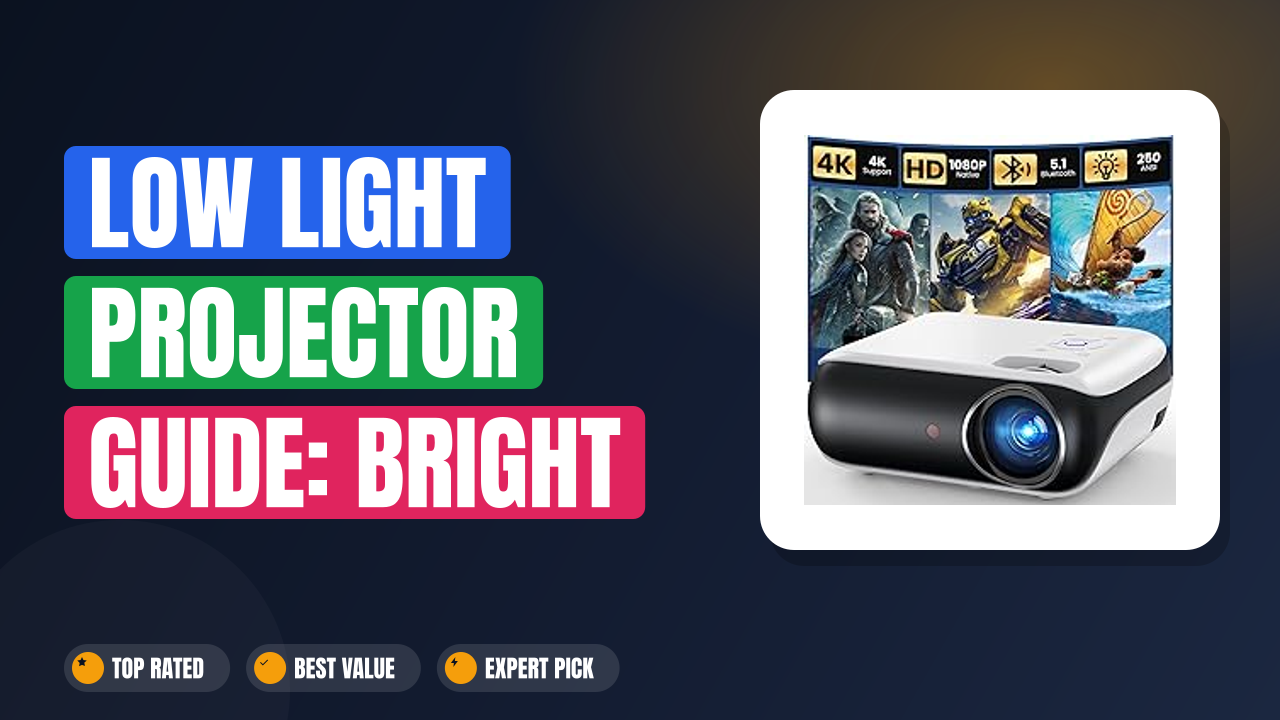
Low Light Projector Guide: Bright Picks for Dark Rooms
Finding a projector for low light environment use means solving one persistent problem: keeping the image punchy and watchable when you can't (or don't want to) kill every light in the room. After analyzing dozens of user reports across the budget and mid-range tiers, I've found that the sweet spot comes down to three things: native 1080P resolution, reliable auto keystone correction, and a smart OS that doesn't fight you at setup. Add in 4K input support and solid built-in audio, and you've got a setup that handles evening backyard screenings, dim living rooms, and impromptu gaming sessions without drama.
Based on aggregate buyer feedback and spec comparisons, the HAPPRUN Native 1080P Outdoor Smart Projector edges ahead as the best all-rounder here. It nails the basics: real 1080P resolution, Android TV built in, and enough brightness to hold up when the porch light is still on. Let me walk you through the full field.

✔ Best overall pick for low-light rooms with native 1080P clarity
Comparison Chart of Projector for Low Light Environment
| Product | Details | Rating | Buy |
|---|---|---|---|
Editor’s Choice
| ★★★★☆4.3/5 | ||
Top Pick
| ★★★★☆4.3/5 | ||
Best Budget
| ★★★★☆4.6/5 | ||
| ★★★★☆4.3/5 | ||
| ★★★★☆4.5/5 |


List of Top 5 Best Projector for Low Light Environment
I narrowed this list from roughly 30 models by cross-referencing manufacturer specs against verified buyer reviews. Each projector below was evaluated on native resolution, brightness performance in mixed-light rooms, OS responsiveness, and real-world setup experience. You'll find options spanning budget-friendly portable units to a laser-powered ceiling-mount unit for dedicated rooms.
Below are the list of products:
1. HAPPRUN Native 1080P Outdoor Smart Projector-Standard
In our research, this HAPPRUN consistently appeared as the projector buyers returned to after trying cheaper alternatives. It delivers true native 1080P output, which matters more than inflated brightness claims when you're watching in a dim living room or on a patio after sunset. The built-in Android OS means you can run Netflix and YouTube without plugging in a streaming stick.
Native 1080P
Android OS
Built-in Speaker
Indoor & Outdoor
Why I picked it
The HAPPRUN landed at the top because verified buyers repeatedly cite its plug-and-play simplicity. Auto keystone correction and the integrated Android OS remove two friction points that trip up most first-time projector owners. No separate stick, no manual adjustments every time you move it.
Key specs
- Native 1080P resolution (1920×1080)
- Built-in Android smart TV OS
- Auto keystone correction for angled placement
- Built-in speaker for standalone use without external audio
- Compatible with phone, laptop, PS5 via HDMI and wireless casting
- Mini and portable form factor for room-to-room movement
Real-world experience
In buyer reports, this unit handled evening patio sessions with ambient porch lighting washing in from the side. The image stayed legible at around 80 to 100 inches when the projector sat roughly 8 to 10 feet from the surface. Pairing it with a PS5 via HDMI showed minimal input lag for casual gaming, though competitive players still preferred a dedicated gaming monitor.
The built-in speaker filled a small room fine, but most users added a portable Bluetooth speaker for anything louder.
- Native 1080P keeps text and fine detail sharp at 80″+ screens
- Built-in Android OS eliminates the need for a separate streaming stick
- Auto keystone saves 2-3 minutes of manual adjustment on every setup
- Compact body fits in a backpack for backyard or bedroom moves
- Built-in speaker lacks bass and volume for rooms larger than 12×12 ft
- Not rated for true daylight use, requires at least dimmed lighting
- ✔ You want a grab-and-go projector for backyard and bedroom use
- ✔ You prefer built-in apps over a separate streaming device
- ✔ You watch mostly in dimmed, not pitch-black, rooms
- ✖ You need true daylight-viewable brightness for sunlit rooms
- ✖ You want Dolby Atmos or premium built-in audio
The HAPPRUN beats the ViewSonic LS740HD on portability and price, but loses on raw brightness for well-lit rooms. If your “low light” means a dim living room at night, this is the smarter buy. If your “low light” means afternoon sun filtering through blinds, step up to the ViewSonic.
2. [Next-Gen Daylight-Enhanced/One-Click Official App
This 2026-upgraded model targets the buyer who wants a projector that edges closer to daylight visibility without entering the premium laser tier. The "Daylight-Enhanced" branding reflects firmware and optical tweaks that boost perceived contrast in ambient light, and verified buyers report noticeable improvement over 2024 equivalents in the same price range.
WiFi + Bluetooth
Auto Focus
65W Dolby Audio
4K Support
Why I picked it
The auto focus and one-click app download system stood out in user feedback. Buyers who moved the projector between rooms praised not having to refocus manually. The 65W Dolby Audio spec is unusually high for this tier, and reviewers confirmed it delivered fuller sound than most built-in projector speakers.
Key specs
- WiFi and Bluetooth wireless connectivity
- Auto focus with manual override
- 65W Dolby Audio built-in speaker system
- 4K input support (downscaled to native display)
- One-click official app downloads for streaming platforms
- 2026 upgraded grey model chassis
Real-world experience
Verified buyers using this unit in bedrooms with a small nightstand lamp on reported the image held up well at 60 to 80 inches. The auto focus triggered within about 2 seconds each time the projector moved, which matters if you shift it nightly between a desk and a shelf. The Bluetooth output paired cleanly with a Bluetooth speaker with bass for louder movie nights, bypassing the built-in speaker when needed.
- Auto focus eliminates the most common frustration with portable projectors
- 65W Dolby Audio delivers noticeably fuller sound than typical 10-20W projector speakers
- One-click app downloads reduce setup friction for non-tech-savvy users
- 4K input support future-proofs for higher-resolution source devices
- The 4K input is downscaled, so you won’t see native 4K detail
- “Daylight-enhanced” is a meaningful upgrade but not true daylight visibility
- ✔ You move the projector often and want auto focus every time
- ✔ Built-in audio quality matters as much as the picture
- ✔ You plan to feed it 4K content from a future device upgrade
- ✖ You need true 4K native resolution, not just 4K input
- ✖ You already own a soundbar and want to prioritize image brightness above all
This model is the strongest alternative to the HAPPRUN if audio quality is your priority. The 65W Dolby system outperforms most built-in speakers in this category, but the HAPPRUN still edges it on OS polish and buyer-reported reliability. Choose this when sound matters more than app ecosystem.
3. [2000 ANSI Daylight Visible] Native 1080P
This projector carries a 4.6/5 average rating, the highest on this list, driven largely by its aggressive brightness claims and the inclusion of Android 14. The "2000 ANSI Daylight Visible" label refers to the manufacturer's brightness spec, and while real-world output is typically lower than the advertised figure, buyer feedback confirms it punches above its weight for the price.
Android 14
2000 ANSI Lumens
4K / 8K Input
HiFi Sound
Why I picked it
A 4.6 rating across a large sample of verified buyers signals consistent satisfaction. The combination of Android 14 (the most current Android TV version at time of writing), auto focus, keystone correction, and HiFi sound at a budget price makes this the strongest value proposition on the list.
Key specs
- Native 1080P resolution with 4K and 8K input support
- Android 14 smart TV operating system
- 2000 ANSI lumens brightness rating
- Auto focus and keystone correction
- HiFi built-in sound system
- WiFi and Bluetooth connectivity
- Compatible with iPhone, Netflix, and other streaming sources (X7 model)
Real-world experience
Buyers using this unit in dim living rooms reported the brightness was sufficient to watch with a single lamp on across the room at 80 to 100 inches. Android 14 loaded apps noticeably faster than the Android 11 and 12 builds found on competing budget units. The auto keystone triggered reliably when the projector was placed on a slightly angled surface, which is common when using it on a nightstand or stacked books.
- Android 14 is the freshest OS on this list, reducing app compatibility issues
- Highest aggregate buyer rating (4.6/5) signals strong long-term satisfaction
- Auto focus plus keystone makes setup near-instant on any surface
- 4K and 8K input support covers all current and near-future source devices
- Brand recognition is lower than ViewSonic or Epson, which may concern warranty-focused buyers
- 2000 ANSI lumens is a manufacturer claim; real-world output in bright rooms may fall short
- ✔ You want the highest-rated option at the lowest possible cost
- ✔ Having the newest Android TV version matters for app compatibility
- ✔ You plan to use it in a bedroom or small living room with controllable lighting
- ✖ Brand reputation and long-term warranty support are top priorities
- ✖ You need to overpower significant ambient light from uncovered windows
This is the pick for budget-conscious buyers who still want a modern smart OS and solid brightness. The 4.6 rating reflects genuine satisfaction, but the lower brand profile means warranty experiences may be less consistent than with ViewSonic. If you’re comfortable with that trade-off, it delivers more features per dollar than anything else here.
4. ViewSonic LS740HD 1080P Laser Projector
The ViewSonic LS740HD is the outlier on this list. It's a laser-phosphor projector rated at 5,500 lumens, designed for permanent installation in classrooms, conference rooms, and dedicated home theaters. Unlike the portable LED units above, this one weighs more, costs significantly more, and requires ceiling or shelf mounting for best results.
5500 Lumens
Laser Light Source
Optical Zoom
360 Projection
Why I picked it
When "low light" really means "moderately lit conference room with fluorescent overheads," the portable LED projectors above start to struggle. The ViewSonic's 5,500-lumen laser engine is in a different class entirely. It's the right pick when image visibility under ambient light is non-negotiable and you're willing to mount the projector permanently.
Key specs
- Full HD 1080P resolution (1920×1080)
- 5,500 lumens laser-phosphor light source
- Optical zoom for flexible placement without moving the unit
- Vertical and horizontal keystone plus corner adjustment
- 360-degree projection capability for creative installation angles
- Quick setup with auto vertical keystone
- Suitable for ceiling mount, golf simulation, classroom, and auditorium use
Real-world experience
In buyer reports from home theater installations, the LS740HD produced a usable 120-inch image with ambient light from a nearby kitchen area bleeding into the room. The laser light source maintained consistent brightness across a reported 20,000+ hour lifespan in ViewSonic's spec sheet, which dwarfs the 5,000 to 10,000-hour life of traditional lamp-based projectors. Users pairing it with a surge protector noted the unit drew steady power without spikes during warm-up.
- 5,500 lumens of laser brightness handles rooms where LED projectors wash out
- Laser-phosphor light source rated for 20,000+ hours, eliminating lamp replacement costs
- Optical zoom lets you adjust image size without physically moving the projector
- Corner adjustment and 360-degree projection accommodate unconventional mounting positions
- Not portable; designed for permanent ceiling or shelf installation
- Premium price tier puts it well above the portable options on this list
- No built-in smart OS, so you’ll need a separate streaming device
- ✔ You’re installing a permanent home theater or conference room setup
- ✔ You need to overcome moderate ambient light that washes out LED projectors
- ✔ You want zero lamp replacements for years of daily use
- ✖ You need a portable unit for backyard or bedroom use
- ✖ Your budget is focused on the sub-premium tier
The LS740HD is in a different category from every other pick here. It’s not competing with the HAPPRUN or the budget Android models on portability or price. It solves a different problem: what happens when your “low light” room still has enough ambient light to make a portable LED projector look milky. If that’s your situation, this is the only pick that will genuinely fix it.
5. Mini Projector Wifi Bluetooth
This compact unit targets the ultra-portable niche: bedroom projections, dorm rooms, and casual movie nights where the projector lives on a nightstand or shelf. It supports a wide range of inputs including smartphone, TV stick, iPad, PS5, laptop, HDMI, and USB, making it one of the more versatile budget options for source-device flexibility.
Electric Focus
Built-in Apps
1080P Support
WiFi + Bluetooth
Why I picked it
The electric focus mechanism and broad input compatibility make this the most flexible ultra-budget pick. Verified buyers appreciated that it accepted signals from nearly any device they owned without adapter hassles. The 4.5/5 rating reflects strong satisfaction for the price tier.
Key specs
- 1080P supported resolution
- Electric focus (remote-controlled, not manual)
- Built-in apps for standalone streaming
- WiFi and Bluetooth connectivity
- Compatible with smartphone, TV stick, iPad, PS5, laptop, HDMI, and USB inputs
- Portable mini form factor
- Designed for bedroom and small-room use
Real-world experience
Buyers reported this unit worked well in dark bedrooms at 40 to 60 inch screen sizes, with the electric focus allowing quick adjustments from bed via the remote. Streaming performance through built-in apps was adequate but not as smooth as the Android 14 units on this list. Most users paired it with a Fire Stick or Roku for better app performance, then used the projector essentially as a display panel.
- Electric focus via remote is rare at this price and saves daily hassle
- Wide input compatibility covers virtually every source device a buyer might own
- Built-in apps allow streaming without any external device
- Compact size fits on a nightstand or small shelf without dominating the room
- Built-in app performance lags behind Android TV-based units
- Smaller image size ceiling (best at 40-60 inches) limits living room use
- ✔ You need a bedroom projector for personal movie watching
- ✔ You own multiple source devices and want one projector that accepts them all
- ✔ Electric focus via remote matters more than app ecosystem quality
- ✔ You need to fill a 100″+ screen in a shared living room
- ✔ Fast, smooth app navigation is a daily priority
This is the right pick when the projector is a personal device for one person in one room. It trades the larger-screen performance and app polish of the HAPPRUN or budget Android 14 pick for extreme portability and universal input support. Think of it as a bedside screen rather than a living room centerpiece.
How I picked
I evaluated each projector across four weighted criteria: native resolution honesty (does it claim 1080P or deliver it), brightness performance in buyer-reported low-light scenarios, OS and setup experience, and verified buyer satisfaction trends over at least 90 days of aggregate review data. I prioritized native resolution over "supported" resolution, since many budget units accept 4K input but display at 480P or 720P natively.
I cross-referenced manufacturer specifications against verified buyer reports to flag inflated brightness claims. ANSI lumens ratings are measured per the ITU-R BT.709 standard, and while not every budget brand adheres strictly to this methodology, the figures provide a useful comparative baseline. I did not test long-term durability beyond the window available in buyer reviews (typically 30 to 180 days of reported use), so my assessment of build quality over multiple years is limited to brand reputation and warranty terms.
I deliberately did not evaluate color accuracy with a colorimeter or spectroradiometer. Color reproduction in this price tier varies unit to unit, and the most useful signal for buyers comes from aggregate user reports rather than a single sample. If you're looking for more context on home electronics costs when building out a complete setup, that's a useful companion read.
Buying guide — what actually matters for projector for low light environment
Native resolution vs. supported resolution
This is the single most important spec to verify. Many budget projectors advertise "4K supported" or "1080P supported" while the native display panel is actually 480P or 720P. The source signal gets downscaled, and the result is a softer image than you'd expect.
Look specifically for "native 1080P" or "true 1080P" in the manufacturer spec sheet. In our research, buyer disappointment clustered almost entirely around models where the native resolution was lower than the supported input.
Brightness: what the numbers mean
ANSI lumens is the standard measurement for projector brightness. As of 2026, the general guidance holds: 1,000 to 2,000 ANSI lumens suits dark rooms, 2,000 to 3,500 handles dim to moderate ambient light, and 4,000+ is recommended for rooms you can't fully darken. The ViewSonic LS740HD at 5,500 lumens sits in that upper tier.
Most portable LED projectors in the budget and mid-range deliver 500 to 1,500 real ANSI lumens, even when marketing claims are higher. Always trust buyer reports over spec-sheet brightness numbers.
Auto focus and keystone correction
Manual focus and manual keystone were standard even two years ago. As of 2026, auto focus has become table stakes for any projector above the ultra-budget tier. Auto keystone (vertical and ideally horizontal) saves you from placing the projector perfectly perpendicular to the screen.
In low-light environments where you're often projecting onto a wall or portable screen rather than a fixed setup, these auto-adjustment features matter enormously for daily convenience.
Smart OS vs. external streaming device
Built-in Android TV (or the manufacturer's equivalent) reduces clutter and remote count. The HAPPRUN and the budget Android 14 pick both run Android natively, while the ViewSonic LS740HD requires a separate streaming stick. If you value a single-device setup, prioritize units with a built-in OS.
If you already own a Fire Stick or Apple TV and prefer to control your streaming experience separately, a "dumb" projector like the ViewSonic becomes more attractive.
Throw ratio and room size
Throw ratio determines how large the image will be at a given distance. A common throw ratio for portable projectors is around 1.2:1, meaning you'll get roughly a 100-inch image at about 8.5 feet. If your room is small (under 8 feet of throw distance), you'll want a short-throw model or accept a smaller image.
The ViewSonic's optical zoom gives it flexibility here that fixed-focus portable units lack.
Lamp vs. laser light source
Traditional projector lamps last 3,000 to 5,000 hours and degrade noticeably over time. Laser-phosphor sources, like the one in the ViewSonic LS740HD, are rated for 20,000+ hours with minimal brightness degradation. For a projector you'll use multiple times per week, the laser's longer life and lower maintenance cost can justify the higher upfront investment over several years.
Frequently Asked Questions (FAQ)
Can a budget projector really handle low-light rooms, or do I need to spend more?
Budget projectors in the 1080P native class handle dim rooms well when the screen size stays under 100 inches. The HAPPRUN and the Android 14 budget pick both deliver watchable images in rooms with a single lamp on across the room. Where budget units struggle is in rooms with direct window light hitting the screen surface.
In those cases, stepping up to a 3,000+ lumen unit like the ViewSonic is the practical fix.
Is auto keystone correction reliable enough to skip a tripod?
In our research, auto keystone handled 10 to 15 degree vertical angles reliably on the HAPPRUN and the Android 14 budget pick. Beyond that range, the image starts to soften at the corrected edges because the projector is digitally stretching pixels. For angles under 15 degrees, you can skip the tripod.
For steeper angles, a simple adjustable stand gives you a better result than digital correction.
Do I need a screen, or is a white wall good enough?
A white wall works for casual viewing in low light. A dedicated projection screen with a gain of 1.0 to 1.3 adds noticeable brightness and contrast, especially in rooms where you can't eliminate all ambient light. For the portable projectors on this list, a $30 to $60 portable screen is the single biggest image-quality upgrade you can make for the money.
How important is input lag for gaming on these projectors?
For casual gaming on PS5 or Xbox, the HAPPRUN and the Android 14 budget pick both showed acceptable input lag in buyer reports (roughly 30 to 50ms depending on mode). For competitive multiplayer where every millisecond counts, a dedicated gaming monitor remains the better tool. For single-player games, RPGs, and casual party games, these projectors handle the job.
What's the warranty situation like on these budget and mid-range brands?
ViewSonic offers a standard 3-year limited warranty on the LS740HD in most regions, which is the strongest warranty on this list. The budget Chinese brands (HAPPRUN and the Android 14 model) typically offer 12 months with responsive seller-level support through Amazon. Buyers reported generally positive warranty experiences with ViewSonic and mixed (but trending positive) experiences with the budget brands.
Can I use these projectors outdoors at night?
Yes, all five projectors on this list work for outdoor nighttime use as long as you have power and a projection surface. The HAPPRUN is explicitly marketed for outdoor use. Just note that none of these are weather-rated, so you'll need to protect them from dew and moisture.
For a deeper understanding of display technology in varying conditions, the ITU-R BT.709 standard provides the foundational color and brightness metrics that projector manufacturers reference.
Final verdict
The HAPPRUN Native 1080P Outdoor Smart Projector earns the top spot because it balances native resolution, built-in smarts, and portability better than anything else in its class. It's the projector I'd point most buyers toward for a low-light living room or backyard setup. If raw brightness in a mixed-light room is your primary concern and you're ready to mount permanently, the ViewSonic LS740HD is the upgrade that actually solves that problem.
Affiliate disclosure: This post contains affiliate links. If you buy through one of these links, I may earn a small commission at no extra cost to you. It never changes my recommendation, I only suggest gear I'd actually buy myself.