What are Electronic Components: Essential Guide to Key Parts Explained
Have you ever wondered what makes your phone, computer, or TV actually work? The answer lies in tiny parts called electronic components.
These small pieces are the building blocks that bring all your favorite gadgets to life. Understanding what electronic components are can give you a new appreciation for the technology you use every day—and maybe even inspire you to create something amazing yourself.
Keep reading, and you’ll discover how these simple parts play a powerful role in the devices you can’t live without.
Electronic Components Basics
Electronic components are the building blocks of every device you use daily, from smartphones to kitchen appliances. Understanding their basics gives you the power to troubleshoot, repair, or even create your own gadgets. Let’s break down the essentials to help you get comfortable with these tiny but mighty parts.
What Are Electronic Components?
Electronic components are small parts that control electric currents in circuits. Each component has a specific role, like directing current flow, storing energy, or amplifying signals. Without these components, your electronic devices wouldn’t function.
Types Of Electronic Components
There are two main types: active and passive components. Active components, like transistors and diodes, can control current and amplify signals. Passive components, such as resistors and capacitors, don’t add energy but regulate or store it.
How Electronic Components Work Together
Components rarely work alone—they connect in circuits. Think of a circuit as a team where each component plays a unique role. The right combination creates a working device, like a radio or a computer motherboard.
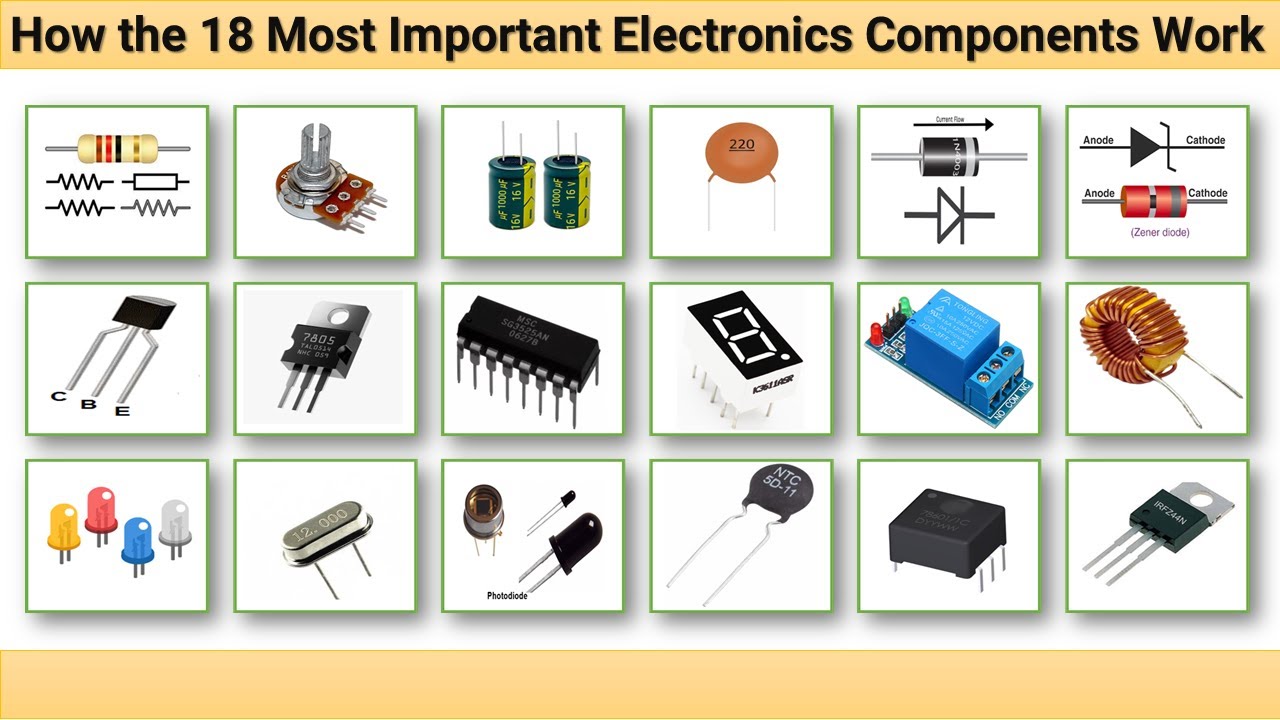
Common Electronic Components You Should Know
- Resistors:Control the flow of electric current.
- Capacitors:Store and release electrical energy.
- Diodes:Allow current to flow in one direction only.
- Transistors:Act as switches or amplifiers.
- Inductors:Store energy in a magnetic field.
Why Understanding Components Matters
Knowing how each component works helps you fix devices or design new projects. It’s like knowing the parts of a car—you can spot a problem faster and avoid costly repairs. What’s one device you’ve wanted to understand better?

Credit: www.electronicsandyou.com
Resistors
Resistors are one of the most common electronic components. They control the flow of electric current in a circuit. By limiting current, resistors help protect sensitive parts. They also set voltage levels and divide voltages. Resistors are essential for almost every electronic device.
Functions And Types
Resistors reduce the current to safe levels. They help maintain the right voltage across components. Their resistance is measured in ohms (Ω). Different types serve various purposes.
- Fixed Resistors:Provide a constant resistance value.
- Variable Resistors (Potentiometers):Allow adjusting resistance manually.
- Thermistors:Change resistance with temperature changes.
- Photoresistors:Change resistance based on light intensity.
Applications In Circuits
Resistors appear in many electronic circuits. They protect LEDs by limiting current. They set bias points in transistors. Resistors divide voltage in sensor circuits. They also filter signals in audio devices.
- Current limiting in LED and motor circuits
- Voltage division for sensors and measurement
- Signal filtering and noise reduction
- Setting timing elements in oscillators and timers
Capacitors
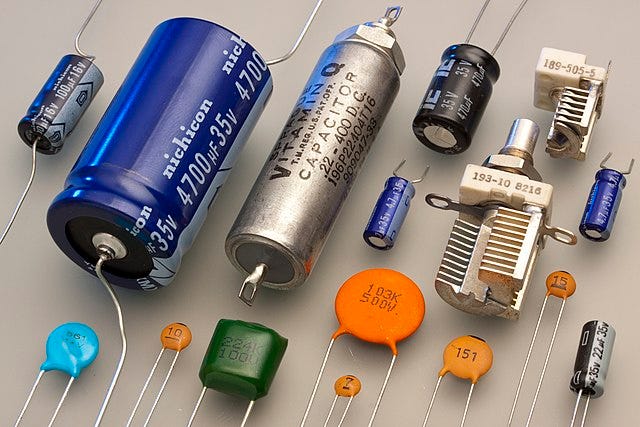
Capacitors are essential electronic components used in many circuits. They store and release electrical energy quickly. Their small size and efficiency make them popular in gadgets, appliances, and industrial machines.
Working Principle
A capacitor stores electrical charge on two metal plates separated by an insulator. When connected to a power source, electrons gather on one plate. This creates a voltage difference across the plates.
The capacitor holds this charge until the circuit needs it. It then releases the stored energy to help maintain steady current flow or filter signals.
Common Uses
- Energy storage in power supplies
- Filtering noise in audio and radio circuits
- Timing devices in clocks and timers
- Improving power factor in electric motors
- Coupling and decoupling signals in amplifiers
Inductors
Inductors are key electronic components used in many circuits. They store energy in a magnetic field when electric current passes through them. This ability helps control current and voltage in devices. Inductors are simple but play vital roles in electronics.
Role In Electronics
Inductors oppose changes in current, smoothing out fluctuations. They filter signals, blocking high-frequency noise while allowing low frequencies to pass. Inductors also work in tuning circuits to select specific frequencies. Power supplies use inductors to maintain steady current flow. They store energy temporarily, helping convert voltages in power electronics.
Types Of Inductors
Inductors come in different forms, each suited for specific tasks. Common types include:
- Air Core Inductors:No magnetic core, used at high frequencies.
- Iron Core Inductors:Use iron core to increase inductance, common in power circuits.
- Ferrite Core Inductors:Use ferrite material, ideal for high-frequency applications.
- Toroidal Inductors:Ring-shaped cores, reduce electromagnetic interference.
Diodes
Diodes are essential electronic components that control the flow of electric current. They allow current to pass in one direction while blocking it in the opposite direction. This simple property makes diodes vital in many electronic circuits. They protect circuits, convert signals, and manage power efficiently.
Rectification Process
The main job of a diode is rectification. This means changing alternating current (AC) into direct current (DC). AC flows back and forth, but most devices need DC to work properly. Diodes only let current flow forward, stopping the reverse flow. This helps in powering devices like phones and radios with steady DC.
In a rectifier circuit, diodes are arranged to convert AC input to DC output. There are two common types:
- Half-wave rectification: Uses one diode to block half of the AC wave.
- Full-wave rectification: Uses multiple diodes to convert the entire AC wave.
Varieties Of Diodes
Different diodes serve different purposes. Each type has unique features and uses in electronics.
- Standard Diode:Used for basic rectification and protection.
- Zener Diode:Allows current to flow backward at a specific voltage, useful for voltage regulation.
- Light Emitting Diode (LED):Emits light when current passes through it, used for indicators and displays.
- Schottky Diode:Has low forward voltage drop and fast switching, ideal for high-speed circuits.
- Photodiode:Converts light into electrical current, used in sensors and solar cells.

Credit: www.reddit.com
Transistors
Transistors are tiny electronic components that play a huge role in almost every device you use daily. They control the flow of electrical current and can either switch it on and off or amplify it. Understanding how transistors work can help you grasp the basics of electronics and even inspire you to create your own circuits.
Switching And Amplification
Transistors act like electronic switches. When you apply a small current to one part of the transistor, it allows a larger current to flow through another part. This switching ability is what makes transistors essential in digital circuits like computers.
Besides switching, transistors also amplify signals. Imagine you’re building a simple radio. The weak signals picked up by the antenna need to be made stronger so you can hear the music clearly. Transistors increase the strength of these signals without changing their content.
Different Transistor Types
There are several types of transistors, but the two most common are Bipolar Junction Transistors (BJTs) and Field Effect Transistors (FETs).
- Bipolar Junction Transistors (BJTs):These have three layers and come in two kinds: NPN and PNP. BJTs control current flow through both electrons and holes, making them suitable for amplification and switching.
- Field Effect Transistors (FETs):These use voltage to control current flow and are more energy-efficient. MOSFETs, a popular type of FET, are widely used in power electronics and digital circuits.
Have you ever wondered why your smartphone stays cool even when running heavy apps? It’s partly because FETs manage power efficiently inside the device. Knowing the type of transistor to use can make a big difference in your circuit design.
Integrated Circuits
Integrated circuits (ICs) are the tiny powerhouses inside almost every electronic device you use daily. They combine multiple electronic components like transistors, resistors, and capacitors into a small chip. This integration allows complex functions to be performed quickly and efficiently in a compact form.
Complexity And Functionality
Integrated circuits can contain millions of components packed into a space smaller than a fingernail. This level of complexity lets them handle tasks from simple amplification to advanced computing. The real magic lies in how these components work together to perform specific functions reliably.
Have you ever wondered how your smartphone fits so much processing power in such a small device? It’s because of ICs that combine logic gates, memory storage, and processors all in one chip. This design reduces size, cost, and power consumption while boosting performance.
Applications In Modern Devices
ICs are everywhere—from the microcontroller in your microwave to the processor in your laptop. They enable devices to process data, control systems, and communicate wirelessly. Without integrated circuits, many modern conveniences would be impossible.
- Smartphones use ICs for everything from touchscreens to cameras.
- Cars rely on ICs for engine control, safety features, and infotainment systems.
- Medical devices use them for monitoring and diagnostics.
Think about the last device you used. Chances are, an integrated circuit played a key role in making it work. What functions do you expect your gadgets to perform next, and how might ICs evolve to meet those needs?
Switches
Switches are fundamental electronic components that control the flow of electricity in a circuit. They act as gateways, allowing you to start or stop the current with a simple action. Whether you’re turning on a light or activating a complex machine, switches play a crucial role in making electronics work the way you want.
Mechanical And Electronic Types
Mechanical switches physically open or close a circuit by moving parts. Common examples include push buttons, toggle switches, and rotary switches. You can feel the click or movement when you operate them, giving you direct control over the circuit.
Electronic switches, on the other hand, use semiconductor devices like transistors or MOSFETs to control current without moving parts. These switches work silently and faster, often controlled by digital signals. You’ll find them inside computers, smartphones, and other advanced electronics where precise and rapid switching is necessary.
Key Applications
Switches appear in countless everyday and industrial applications. In your home, light switches and appliance controls are simple examples. In vehicles, switches manage everything from headlights to engine ignition.
Electronic switches enable essential functions in computers, smartphones, and communication devices. They help regulate power, process signals, and manage data flow efficiently. Have you ever thought about how many switches are working quietly inside your phone right now?
Sensors
Sensors are key electronic components that detect changes in the environment and convert them into signals your devices can understand. They act like the senses of an electronic system, providing real-time data that helps machines respond to their surroundings. Whether it’s measuring temperature, motion, or light, sensors give your gadgets the ability to interact with the physical world.
Functionality In Systems
Sensors play a vital role in making systems smarter and more efficient. They gather data such as pressure, humidity, or sound, and send this information to a control unit for analysis. This allows devices to adjust their operation automatically, improving performance and saving energy.
Think about your smartphone’s proximity sensor that turns off the screen during calls. Without it, you’d accidentally press buttons with your cheek. Sensors like these improve your user experience without you even noticing.
Varieties And Uses
Sensors come in many types, each designed to detect specific physical properties. Here are some common varieties:
- Temperature sensors:Used in thermostats, ovens, and weather stations to monitor heat levels.
- Motion sensors:Found in security systems and automatic lighting to detect movement.
- Light sensors:Help adjust screen brightness on phones or control street lighting.
- Pressure sensors:Used in automotive systems and medical devices to monitor pressure changes.
- Proximity sensors:Detect the presence of nearby objects without physical contact.
What would happen if your car’s tire pressure sensor failed? It could lead to unsafe driving conditions. That’s why choosing the right sensor type for your project is crucial to reliability and safety.
Relays
Relays are essential electronic components that act as electrically operated switches. They allow a low-power signal to control a higher-power circuit without direct electrical connection. This makes them incredibly useful in various applications, from household appliances to industrial machines.
Operation And Design
A relay typically consists of a coil, an armature, and one or more sets of contacts. When you apply a voltage to the coil, it creates a magnetic field that moves the armature. This movement either opens or closes the contacts, controlling the flow of electricity in the circuit.
The design varies depending on the relay type, such as electromechanical or solid-state relays. Electromechanical relays have physical moving parts, while solid-state relays use electronic components to switch currents. Understanding these differences helps you choose the right relay for your project.
Usage In Circuits
Relays can isolate different parts of a circuit, protecting sensitive components from high voltages. You might use them to control motors, lights, or other heavy loads with a small control signal. This makes your circuit safer and more efficient.
Have you ever tried to control a 120V device with a microcontroller? Relays are your go-to solution. They bridge the gap between low-voltage control and high-voltage operation without risking damage to your electronics.
- Switching heavy electrical loads
- Isolating different voltage levels in a circuit
- Automating complex control systems
Crystals And Oscillators
Crystals and oscillators are essential electronic components that help control and stabilize frequencies in circuits. They act as the heartbeat of many electronic devices, ensuring signals stay precise and consistent. Understanding how they work can give you better insights into the timing and performance of the gadgets you use daily.
Frequency Control
Crystals, often made of quartz, vibrate at a specific frequency when an electric current passes through them. This vibration creates a stable frequency that electronic circuits can rely on. Oscillators use these crystals to generate repetitive signals, maintaining a steady clock speed in devices.
Have you ever wondered why your watch keeps perfect time or why your computer runs smoothly? It’s because of this precise frequency control. Without it, signals would drift, causing devices to lag or malfunction.
Applications In Timing
Timing is crucial in many electronic applications, from simple clocks to complex communication systems. Crystals and oscillators provide the timing signals that synchronize operations in microcontrollers, processors, and radio transmitters.
- Digital watches use crystal oscillators to keep accurate time.
- Computers depend on oscillators to coordinate data flow between components.
- Mobile phones rely on crystal timing to manage signal transmission and reception.
Think about your smartphone—its ability to handle calls and apps smoothly depends on these tiny components working flawlessly. What devices around you couldn’t function properly without accurate timing?
Credit: nandasiddhardha.medium.com
Connectors And Wires
Connectors and wires are essential parts of any electronic device. They join different components, allowing electricity to flow and signals to transfer. Without them, circuits cannot work properly. These components come in many shapes and sizes, each serving a specific role in electrical systems.
Importance In Electrical Systems
Connectors and wires ensure stable and reliable connections. They carry electric current safely between parts. Good connectors reduce energy loss and prevent short circuits. Wires provide flexible pathways for power and data. They also help protect circuits from damage by insulation.
Proper connectors and wires improve the lifespan of devices. They make repairs and upgrades easier. Poor connections can cause failures and reduce performance. Quality components keep systems running smoothly and efficiently.
Types And Applications
Connectors come in many types:
- Pin connectors for circuit boards
- USB connectors for data transfer
- Coaxial connectors for cables
- Terminal blocks for wiring
Wires vary by material and size:
- Copper wires for good conductivity
- Aluminum wires for light weight
- Insulated wires to prevent shorts
- Shielded wires to reduce interference
Applications include:
- Power supply connections
- Signal transmission in electronics
- Automotive wiring harnesses
- Home electrical systems
Emerging Technologies
Emerging technologies are reshaping the world of electronic components at a rapid pace. These innovations are not just improving existing devices but are also creating new possibilities for how electronics integrate into daily life. Understanding these changes can help you anticipate what’s next and make smarter choices in your projects or purchases.
Advancements In Electronic Components
Recent advancements have made electronic components smaller, faster, and more energy-efficient. For example, the development of flexible circuits allows devices to bend without breaking, which is crucial for wearable tech. You might already have seen how this impacts fitness trackers or smartwatches that fit comfortably on your wrist.
Materials like graphene are pushing the limits of conductivity and strength in components. This means batteries can last longer and charge quicker, directly affecting how you use smartphones or electric vehicles. These materials also improve sensors, making them more accurate in detecting environmental changes or health data.
Future Trends
Looking ahead, expect electronic components to become even more integrated with artificial intelligence and the Internet of Things (IoT). This means your everyday objects could soon have smarter, more responsive components that learn and adapt to your needs. Imagine a home lighting system that adjusts automatically based on your mood or activity.
Another future trend is the rise of self-healing electronics, which repair minor damages on their own. This could extend the lifespan of devices you rely on daily, saving you money and reducing electronic waste. Have you considered how much longer your gadgets could last if small faults didn’t force you to replace them?
Keeping up with these trends will give you an edge, whether you’re a hobbyist or a professional. What kind of electronic innovations would you like to see in the next decade?
Frequently Asked Questions
What Are Electronic Components Used For?
Electronic components are used to build circuits and devices. They control electrical signals and enable functionality in gadgets and systems.
What Are Common Types Of Electronic Components?
Common types include resistors, capacitors, diodes, transistors, and integrated circuits. Each serves a specific function in circuits.
How Do Electronic Components Affect Device Performance?
They determine device speed, power consumption, and reliability. Quality components ensure efficient and stable electronic operation.
Can Electronic Components Be Reused Or Recycled?
Yes, many components can be reused or recycled. Proper recycling reduces electronic waste and recovers valuable materials.
Conclusion
Electronic components form the heart of all electronic devices. They control and direct electric currents to work properly. Understanding these parts helps you know how gadgets function. Each component has a special role in circuits and systems. Learning about them opens the door to simple repairs and projects.
Keep exploring these basics to build your electronics knowledge. Small parts, big impact.