What is Basic Electronics Components: Essential Guide for Beginners
Have you ever wondered what makes your gadgets work? The secret lies in basic electronic components.
These tiny parts are the building blocks of all the devices you use every day. Understanding them can open up a whole new world for you—whether you want to fix things, create your own projects, or simply satisfy your curiosity.
You’ll discover what these components are, how they work, and why they matter. By the end, you’ll feel confident to explore electronics with a fresh perspective. Ready to dive in? Let’s start uncovering the basics together.
Resistors
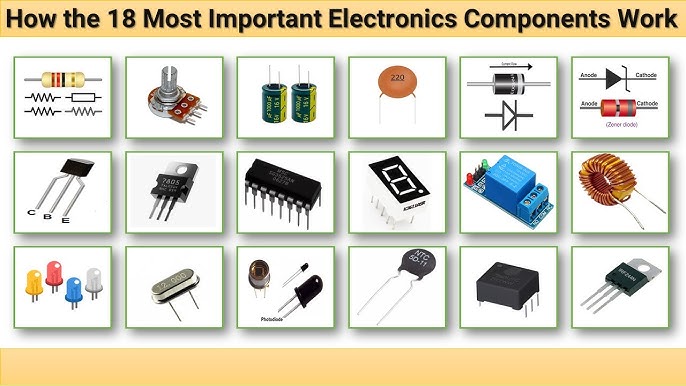
Resistors are one of the most fundamental components in electronics. They control the flow of electric current by providing resistance, which helps protect sensitive parts and manage voltage levels. Understanding resistors is key to building and troubleshooting circuits effectively.
Types And Functions
Resistors come in various types, each serving a specific purpose in your circuit. The most common type is the fixed resistor, which has a set resistance value that doesn’t change. You’ll also find variable resistors, like potentiometers, which allow you to adjust resistance manually.
Carbon film, metal film, and wire-wound resistors are popular based on their accuracy and power rating. Fixed resistors mainly limit current and divide voltage, while variable resistors help you fine-tune circuit performance.
- Fixed Resistors:Stable resistance, used to set current or voltage levels.
- Variable Resistors:Adjustable resistance, useful for calibration.
- Special Types:Thermistors (temperature-dependent) and photoresistors (light-dependent).
Have you ever wondered how your speaker volume control works? That’s a variable resistor in action, adjusting the signal strength.
How To Read Resistor Codes
Resistors are marked with color bands that represent their resistance value and tolerance. Learning to read these codes helps you pick the right resistor without guessing.
The first two bands show significant digits, the third is the multiplier, and the last band indicates tolerance. For example, a resistor with bands red, violet, yellow, and gold translates to 27 × 10,000 ohms with ±5% tolerance.
| Color | Digit | Multiplier | Tolerance |
|---|---|---|---|
| Black | 0 | 1 | — |
| Brown | 1 | 10 | ±1% |
| Red | 2 | 100 | ±2% |
| Orange | 3 | 1,000 | — |
| Yellow | 4 | 10,000 | — |
| Green | 5 | 100,000 | ±0.5% |
| Blue | 6 | 1,000,000 | ±0.25% |
| Violet | 7 | 10,000,000 | ±0.1% |
| Gray | 8 | — | ±0.05% |
| White | 9 | — | — |
| Gold | — | 0.1 | ±5% |
| Silver | — | 0.01 | ±10% |
Try picking up a resistor next time and decode its colors yourself. It’s like uncovering a secret message that tells you exactly how it behaves in the circuit.

Credit: www.electronicsandyou.com
Capacitors
Capacitors are essential components in electronic circuits. They store and release electrical energy quickly. This ability helps circuits work smoothly by controlling voltage and current flow. Capacitors come in many shapes and sizes. Their main job is to hold a charge for a short time and then release it when needed.
Varieties And Uses
Different types of capacitors serve different purposes. Here are some common varieties:
- Ceramic Capacitors:Small and used in high-frequency circuits.
- Electrolytic Capacitors:Larger, with higher capacitance, often used in power supplies.
- Film Capacitors:Stable and reliable, used in audio and filtering circuits.
- Tantalum Capacitors:Compact and efficient, found in mobile devices.
Capacitors help in filtering noise, storing energy, and tuning circuits. They smooth out voltage changes and block direct current while allowing alternating current.
Capacitance Measurement
Capacitance shows how much charge a capacitor can hold. It is measured in farads (F), usually in microfarads (µF) or picofarads (pF). Use a multimeter with a capacitance setting to measure it. Connect the leads to the capacitor terminals carefully. The meter shows the value, which helps check if the capacitor works correctly.
Inductors
Inductors are basic components in electronics that store energy in a magnetic field. They consist of a coil of wire wrapped around a core. Inductors resist changes in current, making them important in many circuits. They help filter signals, store energy, and manage current flow.
Role In Circuits
Inductors control the flow of electrical current. They block sudden changes in current while allowing steady current to pass. This makes them useful in:
- Filtering noise in power supplies
- Creating tuned circuits in radios
- Energy storage in switching power supplies
- Helping in signal processing and timing circuits
They work with capacitors and resistors to shape electrical signals and improve circuit performance.
Inductance Calculation
Inductance measures an inductor’s ability to store magnetic energy. It depends on several factors:
- Number of coil turns
- Coil area
- Length of the coil
- Core material permeability
The formula for inductance (L) in a solenoid is:
| Symbol | Meaning |
|---|---|
| L | Inductance (Henrys, H) |
| N | Number of turns |
| A | Cross-sectional area (square meters) |
| l | Length of coil (meters) |
| μ | Permeability of the core material |
The formula is:
L = (μ × N² × A) / l
Increasing turns or core permeability raises inductance. Larger coil area also increases inductance. Longer coil length reduces inductance.

Credit: www.electronicsandyou.com
Diodes
Diodes are essential components in electronics. They allow electric current to flow in one direction only. This feature makes them useful for controlling and protecting circuits. Diodes are small but play a big role in many electronic devices.
Types Of Diodes
- Standard Diode: Also called a rectifier diode. It converts AC to DC.
- Zener Diode: Allows current to flow backward at a specific voltage.
- Light Emitting Diode (LED): Emits light when current passes through.
- Schottky Diode: Has a low voltage drop and fast switching.
- Photodiode: Generates current when exposed to light.
Applications In Electronics
- Rectification: Converting AC power to DC power.
- Voltage Regulation: Zener diodes keep voltage steady.
- Signal Demodulation: Extracting audio from radio signals.
- Light Indicators: LEDs show device status or power on/off.
- Protection Circuits: Prevent damage from voltage spikes.
Transistors
Transistors are the backbone of modern electronics. These tiny components control the flow of electrical current and act as switches or amplifiers in circuits. Understanding transistors can dramatically improve how you design and troubleshoot electronic devices.
Working Principles
At its core, a transistor controls current between two terminals based on the voltage applied to a third terminal. Think of it as a gatekeeper that opens or closes to let current pass through.
There are two main types of transistors: Bipolar Junction Transistors (BJT) and Field Effect Transistors (FET). BJTs rely on current control, while FETs use voltage control to regulate current flow.
When you apply a small input signal to the transistor’s base (in BJTs) or gate (in FETs), it can switch a much larger current between the collector and emitter or drain and source. This property is what makes transistors essential for amplification and switching tasks.
Common Configurations
Transistors are often used in three basic configurations that affect their behavior and application:
- Common Emitter:Provides voltage amplification and is widely used in audio amplifiers.
- Common Collector:Acts as a voltage buffer with high input impedance and low output impedance.
- Common Base:Offers high voltage gain but low input impedance, suitable for high-frequency applications.
Choosing the right configuration depends on your circuit’s needs. Have you considered how changing transistor setups could improve your project’s performance?
Integrated Circuits
Integrated Circuits, or ICs, are small chips that hold many electronic parts. These parts work together to perform specific tasks in devices. ICs make electronics smaller, faster, and cheaper. They are found in phones, computers, and many home gadgets.
Types Of Ics
ICs come in different types based on their use and complexity. Some common types include:
- Digital ICs:Handle binary data, like computers and logic gates.
- Analog ICs:Work with continuous signals, such as amplifiers and sensors.
- Mixed-Signal ICs:Combine digital and analog functions in one chip.
- Power ICs:Manage power supply and voltage regulation.
Understanding Ic Pinout
Pinout shows the function of each pin on an IC. It helps connect the chip correctly in circuits. Each pin may carry power, ground, input, or output signals.
Datasheets usually provide a pinout diagram. Reading it carefully ensures proper wiring. Incorrect connections can damage the IC or cause the circuit to fail.
Switches
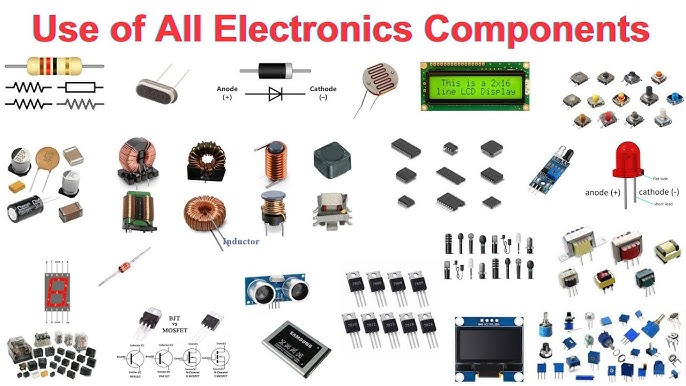
Switches are essential components in basic electronics that allow you to control the flow of electricity in a circuit. Think of them as the gatekeepers—turning the current on or off or redirecting it as needed. Without switches, managing electronic devices would be far more complicated and less efficient.
Types And Mechanisms
Switches come in many shapes and sizes, each designed for specific tasks. Some common types include:
- Toggle Switches:These flip between on and off positions and are easy to use.
- Push-Button Switches:Activated by pressing, they return to their original position once released.
- Slide Switches:Operate by sliding a lever from one position to another.
- Rotary Switches:Rotate to select different circuit paths.
Each switch uses a mechanical or electronic mechanism to open or close the circuit. For example, toggle switches physically move contacts to connect or break the circuit path. This simple action can control complex devices.
Role In Circuit Control
Switches give you direct control over electronic circuits. They act as manual controls that allow you to start or stop the current flow instantly. This is critical not only for turning devices on and off but also for safety and energy saving.
Imagine working on a project where you need to test different parts of a circuit. Having switches lets you isolate sections without unplugging wires constantly. It makes troubleshooting easier and reduces wear on components.
Have you ever wondered how your smartphone manages so many functions with just a few buttons? Switches, combined with other components, make that possible by guiding current exactly where it’s needed. This control is fundamental in designing responsive and efficient electronics.
Credit: www.youtube.com
Batteries
Batteries are essential in electronics. They provide power to many devices, big and small. Without batteries, most gadgets would not work. They store energy and release it as electricity. This stored energy powers circuits and components in electronic projects.
Battery Types
Batteries come in many shapes and sizes. Each type serves different needs. Common types include:
- Alkaline batteries – used in remote controls and toys.
- Rechargeable batteries – such as NiMH and Li-ion, used in phones and laptops.
- Lead-acid batteries – found in cars and backup power supplies.
- Button cells – small batteries used in watches and calculators.
Each type has a different voltage and capacity. Some are single-use, while others can be recharged many times.
Selecting The Right Battery
Choosing the right battery depends on the device’s power needs. Check the voltage and current requirements first. Consider how long the battery should last. Rechargeable batteries are better for frequent use. Single-use batteries may suit devices with low power needs.
Also, consider size and weight. Smaller devices need compact batteries. Safety and environmental impact are important too. Proper battery choice improves device performance and lifespan.
Connectors
Connectors are the unsung heroes of electronic circuits. They provide the physical interface that joins different components and devices, allowing electricity and signals to flow smoothly. Without connectors, assembling, repairing, or upgrading electronics would be a frustrating and time-consuming task.
Types Of Connectors
There are many types of connectors designed for various functions and environments. Some common ones include:
- Pin Headers:Often used on circuit boards for easy connections.
- USB Connectors:Popular for data transfer and power supply in consumer electronics.
- Coaxial Connectors:Used in radio frequency and video applications.
- Terminal Blocks:Enable secure wire connections in industrial setups.
- Ribbon Cable Connectors:Connect flat ribbon cables for compact wiring.
Each type serves a specific role, whether it’s carrying power, data, or signals. Choosing the right connector can improve your device’s reliability and make maintenance easier.
Importance In Circuit Design
Connectors impact more than just how parts fit together; they affect the performance and durability of your circuit. Poor-quality connectors can introduce resistance, noise, or even signal loss, which might cause your project to fail unexpectedly.
Think about the last time you struggled with a loose connection in a device. That small issue can lead to big headaches. By selecting connectors that match your circuit’s needs, you ensure stable connections and easier troubleshooting.
How often do you check the connectors during your projects? Paying attention to these details can save you time and money in repairs or replacements down the line.
Breadboards
Breadboards are essential tools in basic electronics. They allow you to build and test circuits without soldering. This makes them perfect for beginners and experts alike. Breadboards have many small holes to insert electronic components and wires. Inside, metal strips connect these holes in rows and columns, creating circuits quickly and safely.
Using Breadboards For Prototyping
Breadboards help create prototypes of electronic circuits fast. You can test ideas and make changes easily. Insert components like resistors, capacitors, and ICs into the holes. Use jumper wires to connect parts. This setup lets you see how the circuit works before making a permanent version.
Prototyping with breadboards saves time and money. It also reduces the risk of damage to components. You can quickly fix mistakes by moving wires or parts. Breadboards support many types of circuits, from simple to complex designs.
Tips For Effective Use
- Plan your circuit layout before starting.
- Use short jumper wires to keep connections neat.
- Label wires or components if the circuit is complex.
- Keep power supply connections consistent for safety.
- Test each part of the circuit step-by-step.
- Avoid pushing components too hard to prevent damage.
- Check all connections twice before powering the circuit.
Frequently Asked Questions
What Are Basic Electronic Components?
Basic electronic components are fundamental parts used to build circuits. Examples include resistors, capacitors, diodes, and transistors. They control current flow, store energy, or amplify signals. Understanding these helps in designing and repairing electronic devices efficiently.
How Do Resistors Function In Electronics?
Resistors limit the flow of electric current in a circuit. They protect sensitive components by controlling voltage and current levels. Resistors are measured in ohms and come in various types based on resistance and power ratings.
What Is The Role Of Capacitors In Circuits?
Capacitors store and release electrical energy quickly. They filter signals, stabilize voltage, and smooth power supply fluctuations. Capacitors are essential for timing applications and energy storage in electronic devices.
Why Are Diodes Important In Electronics?
Diodes allow current to flow in one direction only, acting as a one-way valve. They protect circuits from damage by preventing reverse current flow and are used in rectification and signal modulation.
Conclusion
Basic electronic components form the foundation of all electronic devices. Resistors, capacitors, diodes, and transistors work together to control electric signals. Understanding these parts helps in building and fixing circuits. Each component has a specific role and function. Knowing their uses makes electronics less confusing.
Start with simple parts and learn step by step. Electronics can be fun and useful for everyone. Keep exploring these basics to grow your knowledge and skills. Small parts, big impact.